

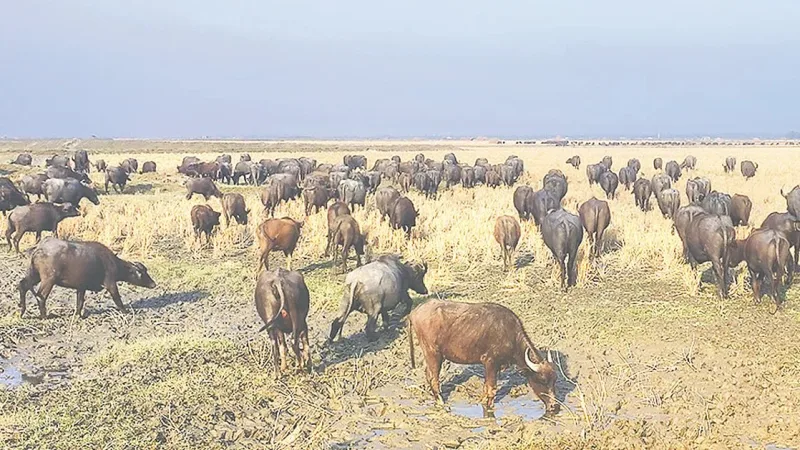
According to Prothom Alo English, the traditional 200‑year‑old ear‑marking system used to prove ownership of coastal buffaloes is no longer accepted as legal proof, putting the livelihood of thousands of farmers at risk.
Around 600,000 water buffaloes are raised on the islands and char lands of eight coastal districts — Barguna, Patuakhali, Barishal, Bhola, Lakshmipur, Noakhali, Feni and Chattogram — in roughly 700 farms, contributing an estimated Tk 55 billion annually to the local milk and meat market.
Herds are declining due to shrinking grazing lands, Forest Department interventions, climate‑induced feed shortages and political pressures, a four‑pronged crisis that experts say threatens the survival of the coastal buffalo farming tradition.
Although climate change is causing severe heat stress and increasing salinity, cyclones, floods and tidal surges, indigenous water buffaloes can survive in wetlands, swim long distances and feed on low‑quality fodder, giving them a higher resilience than other livestock.
The ear‑marking method, while useful for identification, has no legal standing; a 2013 court case in Companiganj rejected the marks and ordered the auction of five buffaloes, illustrating the lack of clear ownership guidelines.
There is no separate policy or clear classification of grazing land in the national land‑management system, forcing herders to move their herds repeatedly and creating administrative and political obstacles.
Buffalo dung and their grazing activity improve the fertility of newly formed ‘poysty’ soils on coastal chars, supporting biodiversity and soil conversion, so the loss of the bathan system would disrupt these ecosystem services.
Herders report a sharp drop in numbers — from about 25,000 buffaloes in Jahajjar Char fifteen years ago to roughly 10,000 now — and describe frequent detentions, cases filed by the Forest Department and the need to sell livestock due to lack of documentation.